

Introduction: Coastal apartment interiors expose doors to repeated humidity swings, so the material choice changes movement, fit, and routine care expectations.
An apartment near the sea rarely stays at one humidity level. Open balconies, sea air, rainy weeks, dry sunny weeks, air conditioning, and cross ventilation all move moisture in and out of the interior. Doors near those openings feel the change first. For architects and design assistants comparing wood doors with WPC doors, the useful question is not which label sounds better. It is how each material responds when indoor humidity rises and falls, how that response shows up in the door leaf and frame, and what routine care follows after installation.

How coastal apartment air changes door moisture exposure
A coastal apartment does not need a flood to stress an interior door. The ordinary pattern is enough: humid air arrives, the door takes in moisture, then drier weather or air conditioning pulls moisture back out. This happens at the door edges, the frame, the bottom rail, and any exposed joint. A door on a corridor may see less of this cycle; a door beside an open balcony sees more. The exposure is still indoors, but it is repeated, seasonal, and strong enough to separate natural wood from a full-thickness WPC composite.
1. Natural Wood Moves as Humidity Rises and Falls
Natural wood is hygroscopic, which means it exchanges moisture with the air. Exposed edges and end grain take up moisture faster than a sealed face, so the leaf can swell on one side or along the bottom edge before the whole door looks wet. As humidity falls, the same wood shrinks again.
That movement can change the door’s flatness, pull the leaf out of square, tighten the gap at the lock strike, or make the door rub on the frame. A finish may crack at a joint or along an edge where movement is concentrated. In a coastal apartment, this is a seasonal fit issue as much as a surface issue.
2. Solid WPC Keeps Its Shape Through Seasonal Swings
A solid WPC door leaf is a full-thickness composite, not a wood core with a decorative skin. The wood fiber is bound in a polymer matrix, and the leaf is formed under heat and pressure. That structure leaves less open grain at the edges to take in moisture quickly. A closed PVC veneer adds a smooth facing surface that is easy to wipe and does not need repainting.
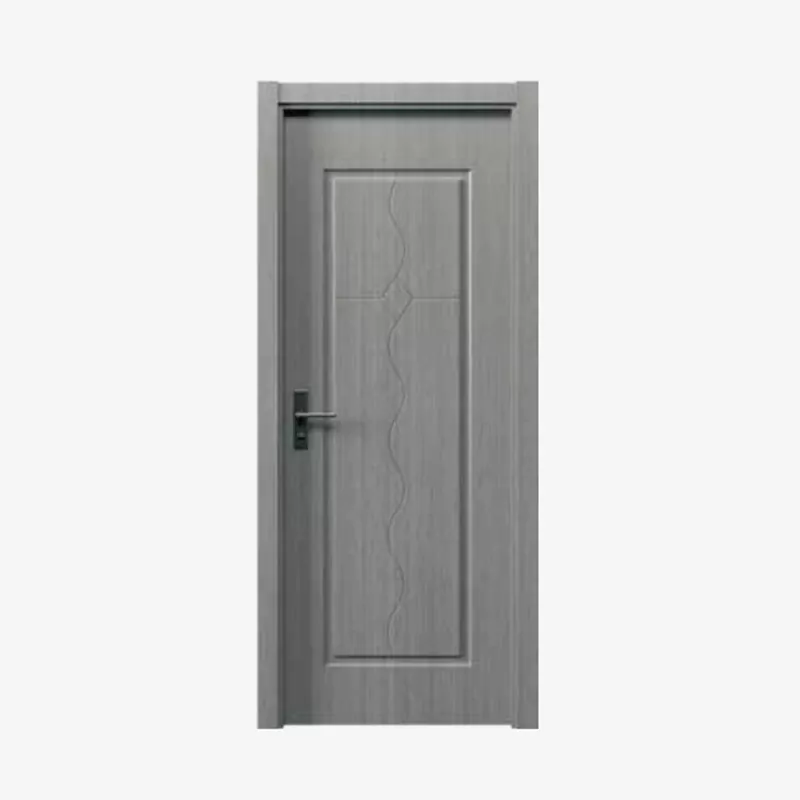
When indoor humidity changes, the composite leaf holds its squareness and flatness more consistently than a wood-core leaf. One example is the Winzone 8304, an indoor swing door with a solid WPC composite leaf and PVC veneer. It is a useful material example for coastal apartment interiors, not a recommendation for every project.
What visual and maintenance differences show up after installation
A practical way to compare the two materials is a maintenance walk-through after a humid stretch. Check the top and bottom edges, the hinge side, the lock strike, and the frame contact points.
On a natural wood door, the common findings are swollen edges, a changed finish at the joints, rubbing marks, and a leaf that needs adjustment as the seasons change. On a solid WPC door with PVC veneer, the edge condition stays more consistent, and the routine task is usually cleaning the facing surface with a damp cloth rather than sanding or refinishing.
Industry references such as AWINET address door-leaf squareness and facing as part of door manufacturing context, while EN 1534 provides a test method for surface hardness and impact resistance. These are industry references, not a certificate for a specific door.
Care also differs between the frame and the leaf. A wood frame and leaf can move at different rates, so seasonal adjustment may involve both. A matched WPC frame and leaf system keeps the same material family on both parts, which makes cleaning and inspection simpler.
A wpc door supplier can provide care guidance for the PVC veneer, mainly around avoiding harsh solvents, abrasive pads, and sharp scraping. A wpc interior door manufacturer can also supply section drawings that show whether the leaf is solid WPC or a wood-core composite.
For a custom wpc interior door, the opening size and wall thickness are confirmed before production, so the frame and leaf arrive as a matched set. That does not remove routine maintenance, but it keeps the care task predictable.
Why indoor material comparisons stop at the exterior door line
An interior door in a coastal apartment is protected by the building envelope. It faces indoor humidity, air movement, and seasonal swings, but it does not face direct sun, driving rain, or wind-driven water. An exterior door faces a different set of conditions: weather sealing, UV exposure, water shedding, impact, and security. Those requirements sit outside this comparison. A WPC interior door is built for indoor swing-door use, and a wood interior door is also an indoor product. The comparison between them belongs inside the apartment, where moisture movement and maintenance access are the real issues.
That boundary keeps the comparison useful. The relevant points are moisture movement at the edges, deformation risk around the leaf and frame, door-leaf squareness, facing surface care, and the routine work each material demands. A wpc door manufacturer should be able to explain the material basis of a door without turning an indoor product into an exterior claim.
A custom WPC interior door can suit many coastal apartment interiors where humidity swings and low-maintenance surfaces matter, but no single door type fits every coastal project. A controlled interior with stable humidity may still make wood a reasonable design choice. The decision is material-based, not brand-based.
Conclusion
Wood interior doors and WPC doors differ most in how they respond to repeated moisture cycles. Natural wood takes in and releases moisture at exposed edges, so fit, flatness, and finish can change with the seasons. A solid WPC composite leaf keeps its squareness and facing more consistently, and its PVC veneer shifts routine care toward simple cleaning. Both are indoor doors, and both sit behind the exterior door line. For a concrete material reference, the Winzone 8304 listing shows a solid WPC composite leaf with PVC veneer for indoor swing-door use.
FAQ
Q: How does humidity affect wood interior doors in coastal apartments?
A: Wood absorbs and releases moisture through exposed edges and end grain. In a coastal apartment, repeated humid and dry cycles can make the leaf swell, shrink, cup, or bind against the frame, and the finish may crack at joints. The result is usually a fit change rather than a single dramatic failure.
Q: Why can solid WPC doors stay more stable than wood doors in coastal air?
A: A solid WPC leaf is a full-thickness composite with wood fiber bound in a polymer matrix, so it has less open grain at the edges to take in moisture quickly. A closed PVC veneer adds a stable facing surface. Together, these features help the leaf hold its squareness and flatness through seasonal humidity swings.
Q: Do coastal apartment doors need different care on the frame and leaf?
A: Yes. On a wood door, the frame and leaf can move at different rates, so seasonal adjustment may involve both. On a matched WPC door with PVC veneer, the frame and leaf share the same material family, and routine care is mainly damp wiping plus checking hinges, locks, and clearance. Harsh solvents, abrasives, and sharp scraping should be avoided on the veneer.
Sources / References
EN 1534 – Surface hardness and impact resistance test method