


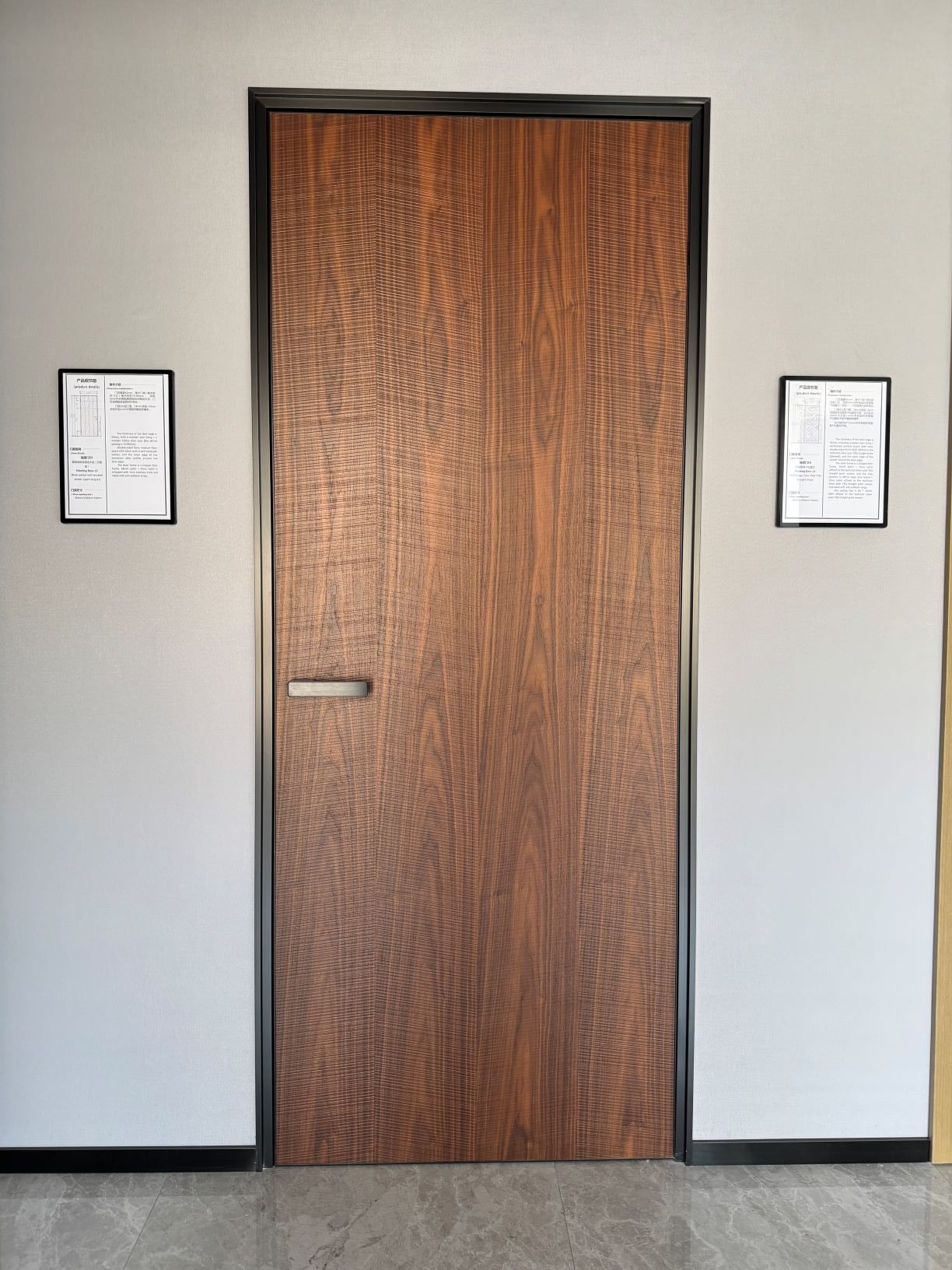
Product Overview
Painted Door 15 is an interior swing door built on a stile-and-rail leaf with a natural wood veneer face, then finished with sprayed paint to a smooth, closed surface. It belongs to the part of our range where the look is settled first and the construction follows: colour, sheen and face detail are decided up front, and the leaf, frame and hardware preparation are built around that decision rather than adjusted afterwards. As a wooden interior door it suits projects where the face is part of the specification rather than an afterthought — guest rooms, apartment schedules and office interiors — and it carries classical moulded profiles and flat modern faces on the same construction. Buyers usually take it as the showroom-facing tier of a range, or build a wholesale wooden door programme around it, with each opening in the schedule carrying its own size and its own colour direction. Inside our painted family it sits beside Painted Door 06, Painted Door 05 and Painted Door 01 — painted wooden doors that share the same paint and colour approach across different face designs. Where a project needs a different surface technology altogether, the carbon crystal, HPL and PVC veneer lines cover that ground and can be quoted alongside this one.
Painted Finish & Colour Control
Under the paint
A painted face is only as good as what sits under it. The leaf is levelled and prepared before any colour goes on, then polished and sprayed in a clean booth. Paint applied to an uneven face telegraphs every ripple once a downlight hits it, and no amount of top coat hides that — the flatness has to be built into the leaf first.
Colour matching
As a painted wooden door manufacturer we mix to your reference rather than pick from a printed film card, which is the practical advantage of paint over a manufactured face. Send a sample, a painted panel or a brand colour and we mix to it, then spray an approval panel for you to sign off before the run begins. Sheen is settled at the same moment as colour, so the two are never negotiated separately later.
Leaf and frame together
Painted wooden doors in this family are sprayed as a set, with the leaf and its frame going through the same batch against the same reference. A frame that is a shade off its leaf is the most common failure in painted work and the hardest thing to correct on site, so it is worth fixing at the spray stage rather than at handover.
Before handover. Construction dust is abrasive, so vacuum or dry-wipe the face before anything wet goes near it — a damp cloth dragged through grit polishes fine scratches into the paint. Leave the protective film on while frames and skirting are being fitted, then take it off as soon as that work is finished; adhesive left in sun or heat can bond to the paint and lift the surface when it is pulled away. Routine cleaning. Use a soft dry cloth for dust, then a damp cloth with a little mild soap for marks, working from the top of the leaf downwards so nothing runs into the edges, and dry the surface straight away instead of letting it air-dry. For a painted interior door in normal use that is all the maintenance required. What to keep off the face. Abrasive pads, scouring cream, thinners, solvent or bleach-based cleaners and adhesive removers all attack the paint film. So does tape left on for weeks, marker and sticker residue picked at with a blade, and any cleaner that claims to remove paint splashes. Water and edges. The bottom edge of the leaf and the frame rebate are where moisture damage starts. Dry up spills promptly, avoid washing floors with the door closed tight against a wet threshold, and check that no standing water collects in the rebate after rain blowing into an entrance hall or balcony door line. Hardware and site conditions. Retighten loose hinge screws and adjust the strike rather than forcing the door shut, because a leaf that is dragged will mark its own frame. Newly finished buildings hold a lot of moisture in the first weeks — ventilate rooms while plaster and screed dry out, and do not seal a room up with the doors hung before that phase passes. Touch-up. A small chip is easiest to deal with while it is small: seal it before moisture reaches the timber underneath, using a little of the approved colour kept on site. If you need touch-up paint with the shipment, raise it at order stage so it can be arranged. Handled this way, painted wooden doors keep their sheen and their colour through handover and the years of occupancy that follow.
Sampling, Production & Inspection
- Requirement review. We start with a meeting, an email thread or a call: the openings, the finish direction, the hardware you plan to use and the budget band.
- Costing and quotation. The complete set is costed and returned as a quotation with the drawing set.
- Drawings or a reference sample. Our designers draw to your requirement, or you send a sample or nominate an existing face. A custom wooden door is approved on the drawing before anything is cut.
- Material preparation. Leaf material, frame material and accessories are pulled for your specification.
- Raw material intake. Timber and boards are checked into the warehouse.
- Cutting. Door leaves and frames are cut to size.
- Leaf and frame build. The stile and rail door takes its shape here: stiles, rails, inner frames and cores are produced and moulded.
- Cold pressing. Automated or microwave pressing closes the leaf.
- CNC processing. Hardware holes are opened, edges trimmed and sealed, and the leaf is brought to its finished thickness.
- Surface treatment. Polishing, paint spraying, cleaning and moisture-proof treatment; after this stage a painted wooden door is ready for assembly. 11. Assembly, inspection and packing. The door leaf and frame set is assembled, hardware is trial-fitted, the face is checked under light, and the doors are then packed, coded and booked into the finished-goods warehouse for scanning and loading.
Leaf, Frame & Hardware Preparation
- Opening and size. For an interior swing door, send the structural opening or the finished leaf size together with the wall thickness. For a custom wooden door we work from your drawing or schedule rather than a stock size list, and we confirm the handing — which side the door swings to — before production.
- Leaf build. The stile-and-rail leaf is assembled around the core you choose, then pressed so both faces stay flat through finishing.
- Frame cut to the same schedule. Frame profile and material are selected for the wall build-up and cut from the same drawings as the leaf, so the two line up when they meet.
- Hardware preparation. Hinge and lock positions are machined on both leaf and frame from your hardware list, so the centres agree and the carpenter is not re-drilling on site.
- Edge sealing. Edges are sealed before painting so that on a painted interior door the paint wraps the edge instead of stopping short of it.
- Face decoration. Moulded panel profiles, grooves or a plain face are confirmed on the drawing and kept consistent between leaf and frame.
- Set check. The door leaf and frame set, together with its preparation, is checked against the schedule before release; nothing leaves as a leaf without its matching frame.
- – Solid particle board: the heaviest fill. This is the core that makes a standard-size leaf read as substantial in the hand and gives a solid, low note when knocked. It suits buyers whose market judges a wooden interior door by weight and closes it many times a day. Because it adds mass, the hinge specification and frame reinforcement are agreed at the same time as the core, never afterwards. – Wooden squares: the traditional stile-and-rail build. A stile and rail door built around wooden squares behaves the way an experienced joiner expects. It takes hinge and lock screws predictably and carries a moulded or panelled face without the fill showing through as a ripple. It is the fill we recommend for classical profiles and for sites where the fitter is used to a traditional leaf. – Bridge-hole mechanical board: consistent, machine-made. The board goes in with even density from top to bottom, which keeps large flat faces stable through pressing and painting and keeps one leaf much like the next across a long run. It is the sensible choice for a plain modern face and for a repeat phase where consistency matters more than heft. – Weight decides the hinge, so settle the core first. A heavy leaf hung on hardware sized for a light one is how doors end up dropped and rubbing within a season. Once the core is fixed we agree hinge positions and the hinge grade you need, and prepare the frame to carry that load. – Tall or wide leaves change the calculation. Extra height or width puts more load on the hinge side, so flag it at drawing stage; the core, the hinge preparation and the frame build-up are then reviewed together rather than one at a time. – Keep one fill across a schedule. Mixing fills within the same run is possible, but the leaves will not feel the same or hang the same, and the difference surfaces as a complaint at handover. Choose the fill per project and hold it. – How the choice is confirmed. The core is written on the drawing and, for a custom wooden door, checked on the approval sample before production. If your team needs to feel the difference first, ask for a sample leaf in the fill you are considering.
Specifications
| Specification | Detail |
| Model | Painted Door 15 |
| Brand | WinZone Door |
| Type | Painted interior door |
| Application | Residential door, Hotel door, Apartment door, Office door, Building projects |
| Place of origin | Qingyuan, Guangdong, China |
| Opening style | Swing |
| Door leaf material | Stile & Rail, internal filling material ( Wooden squares / Bridge-hole mechanical board / Solid particle board ) |
| Veneer type | Natural wood veneer |
| Surface finishing | Painted |
| Surface treatment | Smooth |
| Size | Made to your opening size |
| Production ability | 20000 sets /Month |
| Package | Plastic film + Foam board + Paper carton or customized package |
Customization Areas
| Area | What you can specify |
| Size | Leaf width, height and thickness taken from your opening or drawing |
| Frame | Profile and material matched to the wall build-up and the door finish, supplied as one door leaf and frame set |
| Colour | Paint mixed to your sample, panel or brand reference |
| Sheen | Agreed on an approval panel before the run starts |
| Face design | Classical moulded profiles or flat modern faces |
| Hardware preparation | Hinge and lock positions cut to your hardware schedule |
| Decoration | Panel mouldings, grooves and applied detailing |
| Branding | Logo, label and carton artwork for own-brand and wholesale wooden door programmes |
Ordering & Delivery
- Minimum order. 80 sets per 1×20 ft container, which is the standard basis for a wholesale wooden door programme and the figure the load is planned against.
- T/T.
- Lead time. 30 days after deposit.
- Price basis. EXW, FOB or CIF.
- Port of loading. Foshan, Guangzhou or Shenzhen.
- What to send for a quotation. The opening schedule, the finish and colour direction, your hardware list and any branding or carton artwork. A painted wooden door is quoted as a complete set of leaf, frame and preparation rather than as a leaf on its own.
- More than one model. If the schedule spans several models in the family, say so at quotation stage and we will plan the load with you.
Scale & Supply Capability
Winzone has been manufacturing doors since 2003, with more than 200 staff and a phase-one production base of about 80,000 m² in Yingde, Qingyuan, Guangdong, running automated production lines and supported by a sales office in Foshan. Our range covers the interior door categories we supply, so importers and contractors can build a full door schedule with one partner. OEM and ODM work is routine: leaf, frame, surface, colour, hardware, branding and packing are configured to your drawings, confirmed on samples, then produced. Send your natural wood veneer door schedule and we will quote.
FAQ
Q1. Which core should I choose for the door leaf?
Three fills are used in this leaf: wooden squares, bridge-hole mechanical board and solid particle board. They feel different in use — solid particle board gives the heaviest, most solid-feeling leaf, wooden squares is the traditional stile-and-rail fill behind a moulded or panelled face, and bridge-hole mechanical board is an engineered board core used where a consistent machine-made leaf is wanted. Door size, hinge type and the feel your own market expects all affect the choice, so send the wooden interior door schedule and we will confirm which core we can offer for your specification.
Q2. How does a painted finish compare with a PVC veneer or an HPL door?
Paint is mixed and sprayed, so the shade can follow a design intent rather than a film card, and marks can be touched up on site rather than replaced. A PVC film or an HPL face is a manufactured sheet: it gives a harder, more scrubbable surface but no colour mixing, and damage usually means a new leaf. As a painted wooden door manufacturer we would normally quote paint for guest rooms, apartments, showrooms and offices where appearance carries the project, and point you to the HPL line for heavy-traffic service areas. If you are weighing one against the other on a wooden interior door schedule, send both parts of the project and we will quote them side by side.
Q3. How should painted doors be cleaned and maintained?
Dust with a soft dry cloth, wipe marks with a damp cloth and a little mild soap, then dry the surface straight away. Avoid abrasive pads, scouring cream and solvent-based cleaners, and do not leave water standing along the bottom edge or around the frame. Check the hinge screws once a year and adjust the strike so the door closes without being forced. Painted wooden doors kept this way hold their sheen, and where a mark will not lift, touch-up is the next step rather than replacement.
Q4. What sits under the paint?
A natural wood veneer face over a stile-and-rail leaf. The veneer gives the paint a stable, consistent surface to sit on, which is why the finish reads evenly across the face and over the edges. When you specify a custom wooden door, the face design — plain, moulded or grooved — is drawn and approved before the leaf is built, because the veneer and the paint order both follow that drawing.
Q5. What do I need to measure to order the right size?
Give us either the structural opening or the finished leaf size, plus the wall thickness and the handing — which side the door swings to when you face it. For a frame sitting into a deep reveal, the wall build-up matters as much as the opening width, since the frame is cut to that depth. Where an opening is taller or wider than usual, say so at drawing stage so the core and the hardware can be checked together before production.